
A Condensed History of the Tall Cedar Foundation of the Tall Cedars of Lebanon International
By Harold Wetzler, Supreme Historian
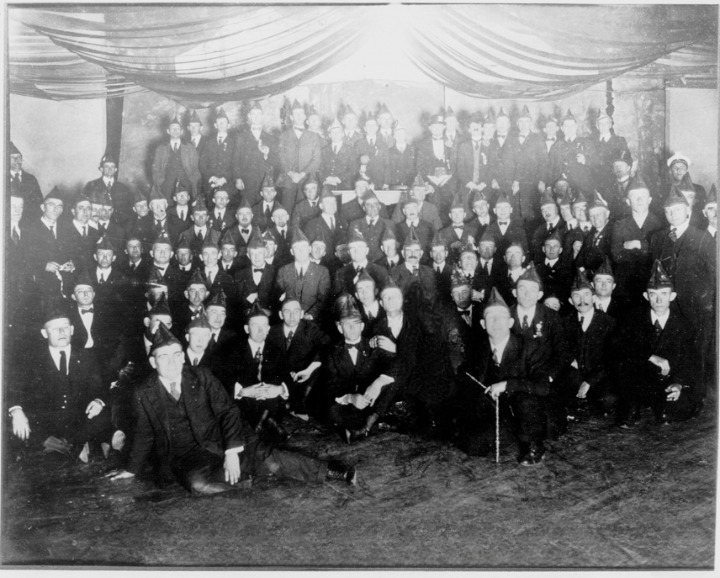
The story of the Tall Cedars of Lebanon begins in 1843, with the creation of a light-hearted Masonic degree known as the Ancient and Honorable Rite of Humility.
Designed as a more relaxed alternative to the formality of Blue Lodge degrees, it was performed from memory by Masons throughout the Mid-Atlantic region during the second half of the 19th century. These gatherings emphasized fellowship, camaraderie, and enjoyment — values that remain central to the Tall Cedars today.
In 1902, the Masons who practiced this degree formally organized as the >Tall Cedars of Lebanon, incorporating the Rite of Humility as the order’s second degree, later renamed the Sidonian Degree. A new initiatory ceremony — the Prologue and Royal Court was also created, firmly connecting the order to the Masonic legends of the Blue Lodge and the story of the building of King Solomon’s Temple.
The initial suggestion for the Tall Cedars of Lebanon to adopt a charitable mission was presented in 1933 at the Supreme Forest Session.
Most Worshipful Grand Master Harry A. Kimball of the Grand Lodge of the District of Columbia, a member of Capitol Forest No. 104, advocated for the organization to pursue a meaningful charity, and was quoted as saying, “No organization could continue to prosper unless it had a definite uplifting objective for the benefit of humanity.”
However, due to the ongoing Great Depression, members felt that the timing was not appropriate for this endeavor.
At the 49th Annual Session of the Supreme Forest in 1951, held in Atlantic City, the committee proposed supporting the Muscular Dystrophy Association of America (MDAA). The association was working to find a cure for muscular dystrophy—a disease affecting many children and posing significant challenges for afflicted families. Some Tall Cedars members had direct experience with muscular dystrophy within their own families, which reinforced the importance of this cause.
Because the disease was not widely known at that time, two speakers were invited to address the Tall Cedars during an open session: Mr. Colby, whose son was diagnosed with muscular dystrophy, and Mrs. Allen, who was confined to a wheelchair due to the disease. They explained that approximately 200,000 people in the United States suffered from muscular dystrophy and only two hospitals worldwide were researching the disease, with one facing closure due to insufficient funding. The speakers, along with others, formed a committee to prevent the hospital’s closure and sought organizational sponsorship to fund further research.
After the presentations, the convention reconvened in closed session to discuss adopting and financing the Muscular Dystrophy Association of America’s work to the extent possible.
Between May 1951 and May 1952, the Supreme Forest Committee led by Chairman William F. Schmidt (PSTC No. 66) worked diligently. A new corporation, the Tall Cedars of Lebanon Muscular Dystrophy Fund, was organized under New Jersey law, thanks to pro bono legal assistance from A. Leslie Price (PGTC No. 8). Fifteen Tall Cedars were appointed to the Board of Trustees, with annual appointments made by the Supreme Forest’s elected officers. This marked the official beginning of the Tall Cedar Charitable Objective.
At that time, the Muscular Dystrophy Association of America was struggling to survive. The Tall Cedars of Lebanon provided crucial assistance, and their efforts, alongside those of the MDA, Jerry Lewis, and others, helped establish the Muscular Dystrophy Association Labor Day Telethon, which went on to raise millions of dollars annually. The Tall Cedars became not only the first fraternal organization to partner with the MDA, but likely the first organization of any kind to do so.
In collaboration with the MDA, plans were made to establish the Tall Cedars of Lebanon Muscular Dystrophy Metabolism Ward at the New York Hospital, Cornell Clinic. The estimated cost was $33,000 to establish the ward and $50,000 annually for its maintenance, allowing for three patients to receive 24-hour care. The initial $33,000 was paid during the first year to set up the ward. On March 18, 1953, the medical community previewed the ward, receiving enthusiastic praise. The official opening took place on April 18, 1953, marked by a plaque reading:
"Tall Cedars of Lebanon Muscular Dystrophy Metabolism Ward 1953"
By 1957, plans were announced for a new ten-story Institute for Muscle Diseases building, with an entire floor designated for the Tall Cedars Metabolism Unit. This expansion enabled care for 12 patients instead of three. In 1959, the unit moved to the Institute at 515 East 71st Street, New York City, occupying the tenth floor. The dedication on September 19, 1959, was attended by Supreme Tall Cedar C. Burnett Freas, elected officers, board members, and many Tall Cedars and their families.
On April 12, 1960, the N.C.O. Board presented a $25,000 check to the Institute to complete and furnish the unit. That year’s annual Christmas party brought joy to the patients once again.
Within three years, the Tall Cedars established the world’s first metabolism ward dedicated to the study of muscular dystrophy.
Though a cure for muscular dystrophy had not yet been found, Dr. Milhorat, a leading authority and head of the ward, noted that research sometimes leads to unexpected discoveries. In this case, vitamin E produced in patients’ bodies was found to treat a serious liver disease.
In 1965, The Tall Cedars created a special fund to enable patients and attendants to attend the Convention in Atlantic City, NJ as guests, participate in a baseball game, and attend the Area Conference. Financial support was also provided to their Boy Scout Troop.
In 1967, Dennis Stevens, a long-term patient, delivered a taped message at the convention, expressing gratitude for the support and care he received. The Muscular Dystrophy Association presented a bronze plaque to the Supreme Forest reading:
“The Muscular Dystrophy Association of America expresses profound appreciation of the Tall Cedars of Lebanon for the devotion with which they have supported their National Charitable Objective, the medical conquest of Muscular Dystrophy.” – 1966.
By 1966, Life Memberships had grown to 574, with total Tall Cedars membership at 3,588. Maintaining the unit at the Institute now cost over $88,000 annually, leading to the introduction of a $2.00 per-member contribution to meet financial obligations. This contribution became the standard for Forests seeking Honor Roll recognition.
In 1965, The Tall Cedars created a special fund to enable patients and attendants to attend the Convention in Atlantic City, NJ as guests, participate in a baseball game, and attend the Area Conference. Financial support was also provided to their Boy Scout Troop.
In 1967, Dennis Stevens, a long-term patient, delivered a taped message at the convention, expressing gratitude for the support and care he received. The Muscular Dystrophy Association presented a bronze plaque to the Supreme Forest reading:
“The Muscular Dystrophy Association of America expresses profound appreciation of the Tall Cedars of Lebanon for the devotion with which they have supported their National Charitable Objective, the medical conquest of Muscular Dystrophy.” – 1966
By 1966, Life Memberships had grown to 574, with total Tall Cedars membership at 3,588. Maintaining the unit at the Institute now cost over $88,000 annually, leading to the introduction of a $2.00 per-member contribution to meet financial obligations. This contribution became the standard for Forests seeking Honor Roll recognition.
In 1969, The Singing Cedars recorded “Melody of Christmas” with RCA, donating all profits to the N.C.O. Fund. Additional funds were raised through memorials, life memberships, direct contributions, and sales of candy and stamps. Investments ensured a strong financial future for the N.C.O.
In 1971, the MDAA announced the closure of the metabolism unit at the Institute for Muscle Diseases, citing insufficient research benefits for the operational costs. Subsequently, the N.C.O. Fund partnered with the MDA to sponsor the Jerry Lewis/Tall Cedars of Lebanon summer camp program and made grants to research foundations.
In 1974, the N.C.O. Fund was officially adopted as the charitable undertaking of the Tall Cedars of Lebanon, transitioning from a sponsored project to a separate entity. A $2.00 annual assessment for the National Objective fund was approved, to be levied on each member beginning in 1975, except for those with Life Memberships. The National Charitable Objective Fund was renamed the Tall Cedar Foundation, with an executive committee of seven members established to govern its affairs.
For the first time since 1951, all Tall Cedars members contributed to the charitable mission.
In 1979, under Supreme Tall Cedar John M. Smith, Jr. and Chairman Robert Nibblett, new fundraising initiatives were launched, including a rugby game in Passaic, New Jersey, raising $528.41. The Rose Program was introduced, generating $5,261.26, and the annual appeal letter campaign raised $28,090.50. During Nibblett’s three-year chairmanship, over $600,000 was raised and contributed to MDA research.
In 1980, Raymond F. McMullen became Supreme Tall Cedar, and Stanley A. Temple took over as Foundation Chairman. The Rose Program continued to expand, providing both fundraising and public exposure for the Tall Cedar Foundation’s support of children with muscular dystrophy.
In 2023, the Tall Cedars’ Foundation evolved its focus from solely supporting the MDA to one that recognizes the need to support families of children with muscular dystrophy, as well as a continued partnership with non-profits engaged in research and development work to find a cure.
As part of a new strategic planning initiative, the Foundation has adopted a revised mission, vision, and guiding principles.
By Utilizing the funds in the Muscular Dystrophy Relief Fund (MDRF), the Foundation provides direct support to families through grants to enhance their child’s quality of life by providing grants for medical/therapeutic care, adaptive/mobility equipment, scholarships to summer camps and more designed to improve the quality of life of those affected by muscular dystrophy.
Moreover, we continue to collaborate with other nonprofits that work directly with researchers seeking to develop therapeutics and ultimately discover a cure. With this shift, the Foundation transitioned from benefiting a singular entity to showcasing its collaborative spirit—which has a direct impact on the lives of families in our local communities.